Arthur Holm solutions are specified in corporate headquarters, government institutions and high-end architectural projects worldwide. This white paper reflects direct technical experience in professional AV control integration across major control platforms.
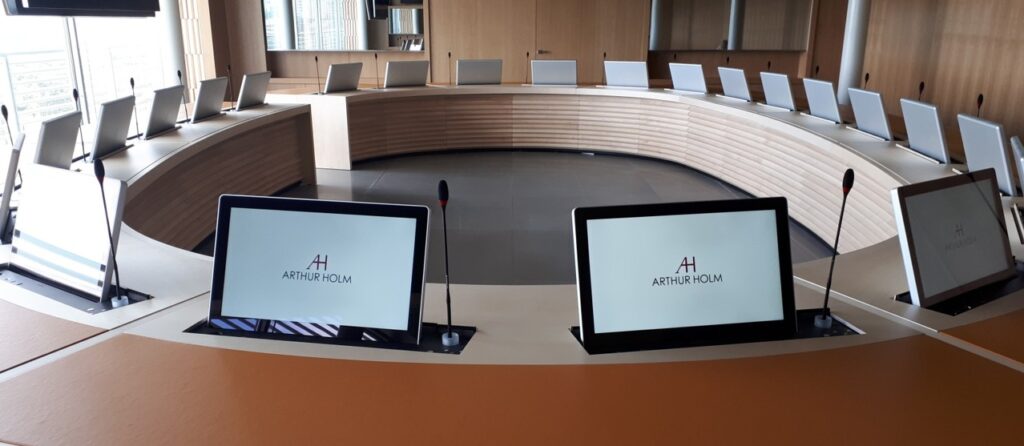
A retractable motorized monitor that rises and lowers on command from a room control system is not the same thing as a retractable monitor that a user operates manually. The difference is not merely one of convenience — it is architectural. When monitors are integrated into a room control system, they become part of a coordinated environment: they rise when a meeting starts, retract when it ends, respond to room scenes, synchronize with lighting and audio, and can be monitored and diagnosed remotely without physical access to the table.
Getting that integration right requires a clear understanding of the control architecture that Arthur Holm systems use, how to commission it correctly, and how to avoid the most common mistakes that create problems after handover.
All Arthur Holm motorized monitors and other motorized products communicate via AHnet —this protocol is based on RS-422/RS-485 Full Duplex serial protocol that forms the control backbone of every professional Arthur Holm installation. Understanding AHnet is the starting point for any control system integration. From now on we will refer to this protocol as AHnet.
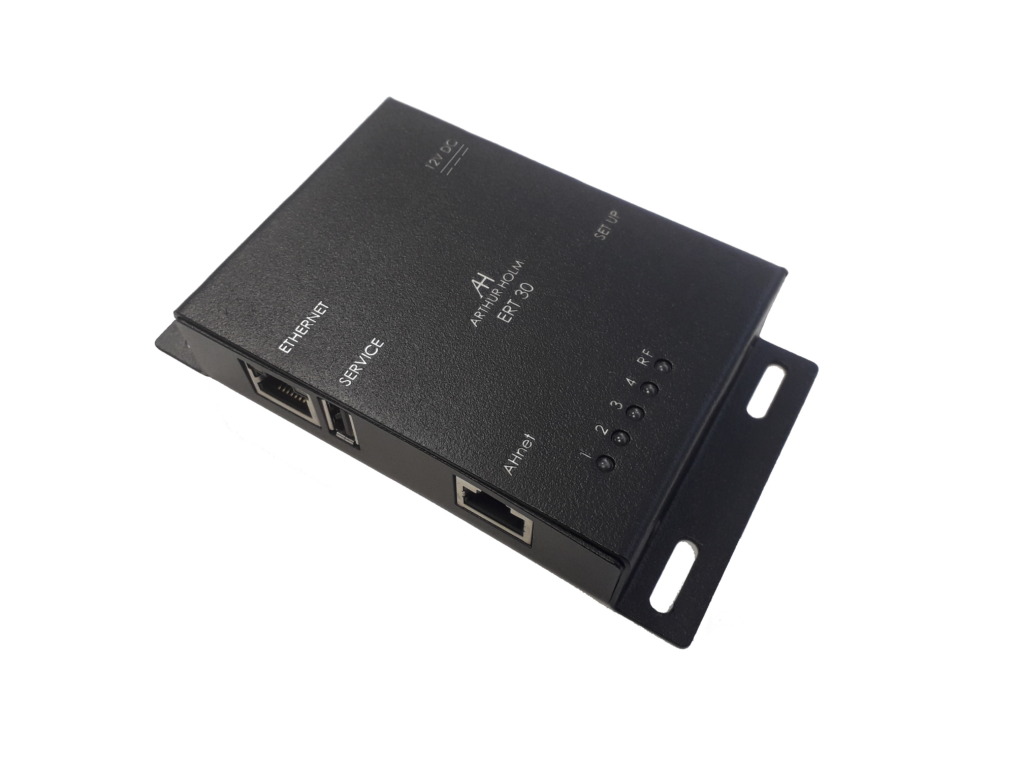
In most professional Arthur Holm installations, the ERT is the recommended central interface between the AV control system and the AHnet bus. It bridges the room’s AV control system to the RS-422/RS-485 Full Duplex monitor bus, and provides IP-based access for commissioning, diagnostics and remote management. By acting as the single gateway to the AHnet bus, the ERT ensures stable communication, simplifies integration, and centralises all monitoring and configuration tasks.
Learn more about How to control motorized retractable and foldable monitors in AV systems with Arthur Holm in our last White Paper.